Power for AI, without the wait.
New grid connections take years. We put AI computers on connections that already exist: spare power at farms and businesses, and unused power at charging stations.
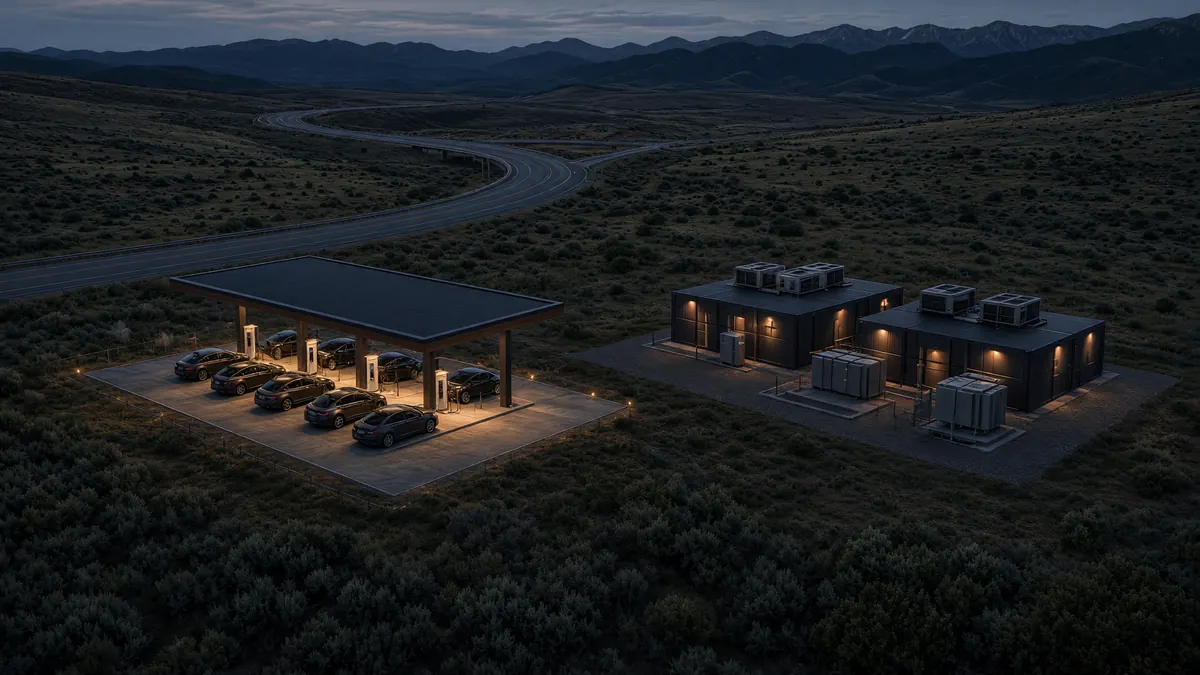 Concept drawing
One power connection. Two businesses that need it.
Small and fast, or big.
Both start with the same idea: the power is already there. This short video explains both in under two and a half minutes.
Read the transcript
AI runs on electricity. And right now, the hardest thing to get isn't a computer chip. It's a connection to the power grid. New data centers can wait years for the utility to hook them up. Meanwhile, lots of places already have big power connections that sit mostly unused. Ridgemont finds that unused power, and puts it to work running AI computers. We do it two ways.
Path one: host sites
Picture a farm, or a local business, with more electrical capacity than it uses. We set up a compact cluster of AI servers right there, on its own meter, with fiber internet and cooling. Companies building AI rent those servers by the hour, around the clock. The site owner earns income from power they already had. Ridgemont designs it, builds it, and keeps it running.
Path two: charging-site headroom
Path two is bigger. It starts at EV fast-charging stations. A fast charger needs a huge power connection, but only while a car is plugged in. Most of the day, that connection sits nearly empty. So we fill the empty space with AI computing, at megawatt scale. Chargers always come first. When drivers need the power, the computers step back. And because the computers run all day, the cost of that big connection gets shared, so charging gets cheaper to operate. A hardware partner brings the servers. Ridgemont brings the scarce part: a live power connection, ready now, not years from now.
Side by side
So, side by side. Host sites are small and fast, using spare power at farms and businesses. Charging sites are large, using the idle headroom behind EV chargers.
What a site needs
So, what does a site need? A host site needs about a hundred to two hundred kilowatts of spare power, business fiber nearby, room for about two parking spaces, and an owner who wants to earn from it. A charging site needs a live connection with a megawatt or more of idle headroom, the utility's okay, a lease that allows computing, and controls that always put chargers first. If a site checks those boxes, it fits one of our two paths.
Two paths. One idea. The power is already there. We put it to work. Ridgemont Energy Capital.
Small: spare power at farms and businesses.
A compact group of AI servers on its own meter, rented by the hour to AI companies. The owner earns from power they already pay for. We design, build and run it.
- About 100–200 kW of spare power
- Fast internet nearby and room for about two parking spaces
- An owner who wants to earn from the servers
Big: unused power at charging stations.
Computing fills the hours when no car is charging, and slows down the moment a driver plugs in. A partner brings the servers. We bring the live connection.
- A connection with 1 MW or more sitting unused
- The utility's OK, and a lease that allows computers
- Controls that always put chargers first
Two businesses that are better together.
A charging station needs a huge connection but uses it only in short bursts. Computers run all day. Put them on one line and the cost of that big connection gets shared.
Power now
A live, approved connection instead of years of waiting.
Much cheaper power
Power costs drop about 80 percent in our estimate.
Better use of its lines
Steady use of existing wires, with a hard limit that's checked and recorded.
One connection. One brain. Chargers first.
Our Switchback software decides how much power each charger, server and battery can use, second by second. When a driver plugs in, the computers step back.
Patent pending: a U.S. application covers how our software shares one power line between EV chargers and computers.
The hard part is the wiring, not the deal.
Drawing computers on a site plan is easy. Getting them powered, inspected and insured is where most attempts stop.
- Code
Two big loads on one line
Electrical code requires extra room for equipment that runs for hours. Two of them can overload a line, unless a system actively keeps the total under the limit. Ours does.
- Hardware
Some servers can't slow themselves down
So we control power at the outlet instead. Chargers stay first either way.
- Cooling
Keeping servers cool
We size the cooling to the site's real weather, not a guess.
- Utility
The utility has to agree
Adding a lot of steady power use takes a study and sometimes a new rate. That's our specialty.
We bring the power. You bring the computers.
Partners who are best set up to own servers buy them. We bring the hard-to-get part: the live connection, the utility approvals and the controls.
Rent the space
Power, space and cooling at a live site, priced per kilowatt.
Ready-to-use building
A small building built to your specs, powered and metered, with chargers-first rules in the lease.
Joint ownership
Share ownership of the site and building when the numbers make sense.
Site details, utility letters and numbers are shared under NDA.
Have land, spare power or solar that could earn more?
Landowners, utilities, computer companies and investors: you'll talk with an owner of the company, usually within one business day.